

Blog Detail
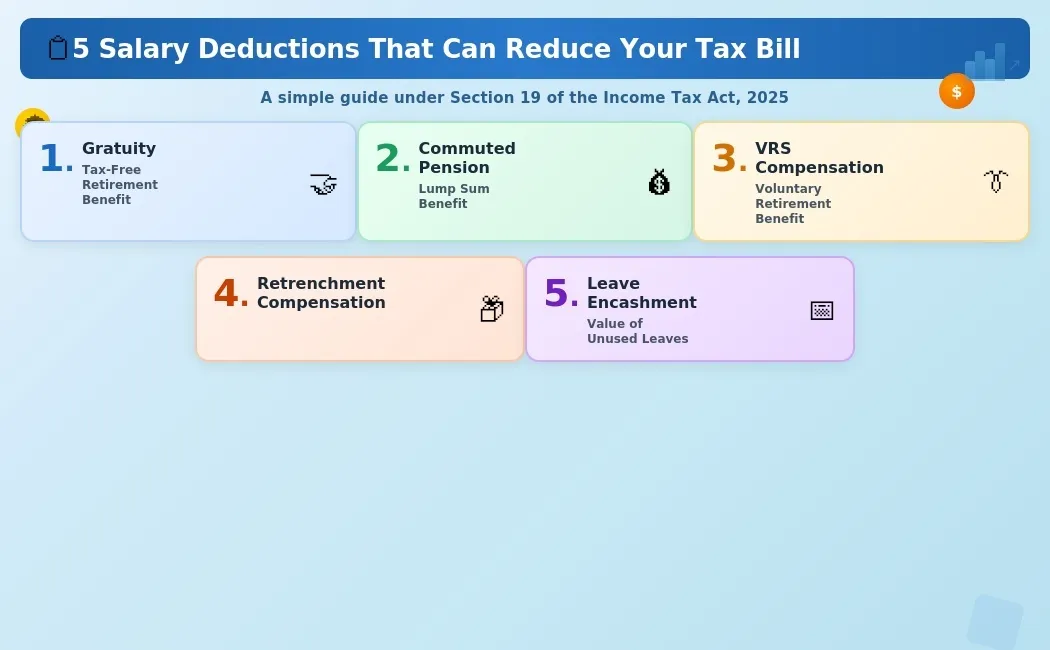
📘 5 Salary Deductions That Can Reduce Your Tax Bill
1. Gratuity – Tax-Free Retirement Benefit
- Government employees → Fully exempt
- Private employees → Exemption = least of:
• Actual gratuity received
• ½ × average salary × years of service
• Government limit
👉 Example: Rahul works for 25 years and his average monthly salary (last drawn) is ₹50,000.
Gratuity as per formula =
½ × ₹50,000 × 25 = ₹6,25,000
Assuming this is within the government limit and actual amount received, the entire ₹6,25,000 will be tax-free.
2. Commuted Pension – Lump Sum Benefit
- Government employees → Fully exempt
- Private employees:
• 1/3 exempt (with gratuity)
• 1/2 exempt (without gratuity)
👉 Example: Sunita receives ₹12 lakh with gratuity
Exempt = ₹4 lakh | Taxable = ₹8 lakh
3. VRS Compensation - Voluntary Retirement Benefit
Exempt up to ₹5,00,000 (once in lifetime).
Conditions: scheme must apply uniformly and aim at workforce reduction.
👉 Example: Priya receives ₹7,00,000
Exempt = ₹5,00,000 | Taxable = ₹2,00,000
📌 Note: Benefit can be claimed only once; timing matters for tax planning.
4. Retrenchment Compensation
Retrenchment compensation is paid when an employee is terminated due to business reasons like downsizing or closure.
Exemption = least of:
• Actual amount
• Industrial Disputes Act calculation
• Government limit
👉 Example: Ravi receives ₹3,00,000
Eligible exemption as per Industrial Disputes Act = ₹2,50,000
Taxable = ₹50,000
📌 Note: Always compute carefully—exemption is restricted to the lowest value.
5. Leave Encashment – Value of Unused Leaves
- Government employees → Fully exempt
- Others → Least of:
• Actual amount
• 10 months’ salary
• Leave (max 30 days/year)
• Government limit
👉 Example 1: Anita receives ₹80,000 → Fully exempt (within limits)
👉 Example 2: Suresh receives ₹5,00,000 as leave encashment
- 10 months’ salary = ₹4,00,000
- Leave calculation = ₹3,60,000
- Government limit = ₹3,00,000
Exempt = ₹3,00,000 | Taxable = ₹2,00,000
🔹 Key Takeaways
✔ Many retirement benefits are partially or fully tax-free
✔ Limits apply—excess becomes taxable
✔ Some deductions (like VRS) are one-time
✔ Proper planning can save significant tax
⚠️ Pro Tip
Correct classification and calculation are crucial. Misreporting can lead to extra tax or notices.
📌 Conclusion
Salary taxation is not just about income—it’s about deductions. Understanding Section 19 helps you avoid overpaying tax and plan finances better.
🔖 Hashtags
#IncomeTax2025 #SalaryIncome #TaxPlanningIndia #StandardDeduction #GratuityTax #LeaveEncashment #VRS #TaxSavings #IncomeTaxAct #FinanceTips #TaxAwareness #DirectTax #TaxIndia #WealthPlanning

 Call Now