

Blog Detail
What Does “Supply” Really Mean Under GST— and Why Should Business Owners Care?
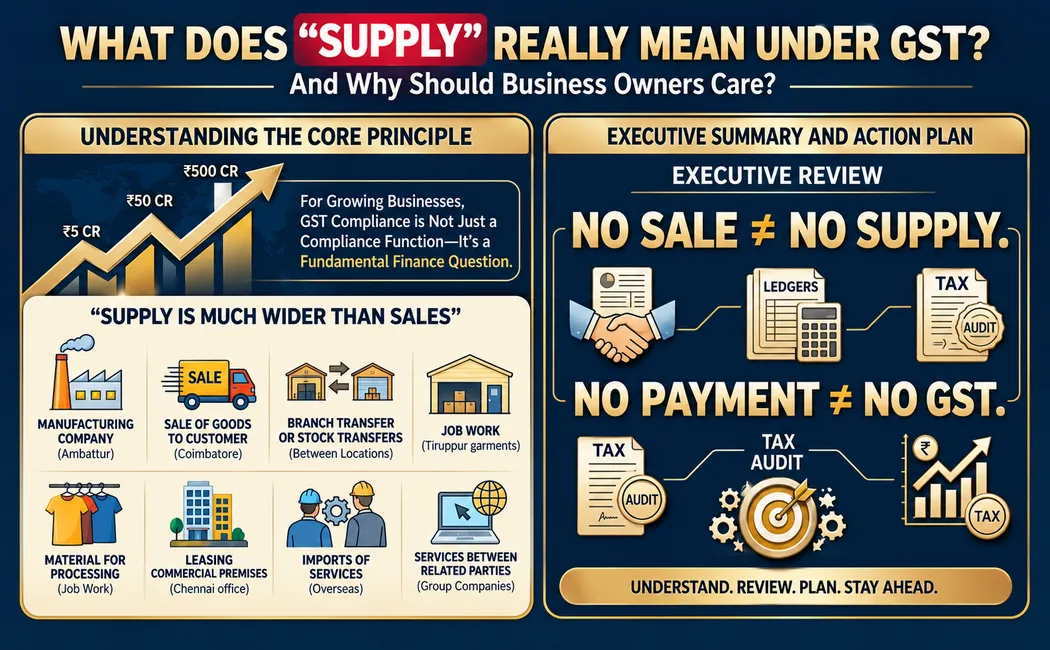
For a ₹5 crore business, GST may look like a compliance function. For a ₹500 crore business, it may look like a finance function. But in both cases, one fundamental question comes first:
Has there been a “supply” under GST?
Many GST issues do not begin with the tax rate. They begin with the nature of the transaction itself.
Under GST, “supply” is much wider than a normal sale.
Consider a manufacturing company in Ambattur with a turnover of ₹75 crore. Selling goods to a customer in Coimbatore is clearly a supply.
But what about stock transfers between separately registered establishments, related-party transactions, job work, business assets, commercial property rentals or services received from related overseas entities?
These transactions may also require GST examination.
As businesses grow from ₹5 crore to ₹50 crore and eventually ₹500 crore, such transactions become more common. There may be multiple GST registrations, branches, warehouses, related entities and centralised support functions.
Under Schedule I of the CGST Act, certain transactions can qualify as supply even without consideration.
No sale does not automatically mean no supply.
No payment does not automatically mean no GST.
For example, imagine a Chennai-based engineering business with separately registered establishments in Sriperumbudur and Hosur.
Management may consider movement of goods or certain support between them simply as an “internal transaction.”
Under GST, however, separately registered establishments of the same legal entity can be treated as distinct persons. Certain transactions between them may therefore require examination for GST, valuation, invoicing and documentation.
What should business owners do?
Ask your finance or GST team to periodically review:
• Branch and stock transfers
• Transactions between GST registrations
• Related-party transactions
• Job work arrangements
• Free supplies and business assets
• Commercial property rentals
• Imports of services from related entities
• Barter and exchange transactions
For each significant transaction, ask:
1. Is it a supply under GST?
2. Is GST applicable?
3. How should it be valued?
4. Is the documentation complete?
The key takeaway is simple:
GST compliance should not stop with GSTR-1 and GSTR-3B.
A quarterly review of transactions outside the normal sales process can help identify issues early and reduce surprises during reconciliation or departmental scrutiny.
For a growing business, understanding “supply” is not merely a GST definition — it is an important part of building a stronger tax-control system.
— CA Sailesh Bhandari

 Call Now