

Blog Detail
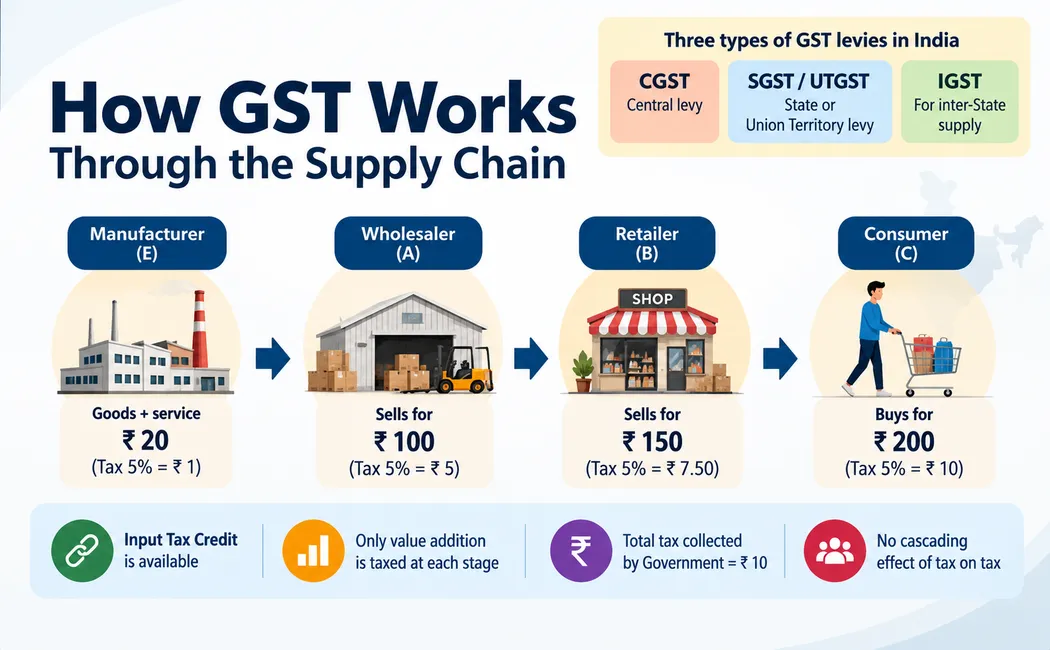
HOW DOES GST WORK?
GST becomes much easier to understand when you look at it as a chain.
At every stage, a business collects GST on its sale and can generally claim credit for eligible GST already paid on its purchases.
THREE TYPES OF GST LEVIES
• CGST + SGST – supplies within the same State.
• CGST + UTGST – supplies within an applicable Union Territory.
• IGST – inter-State supplies and imports.
For example, a sale from Chennai to Coimbatore generally attracts CGST + SGST, while a sale from Chennai to Bengaluru generally attracts IGST.
HOW GST FLOWS THROUGH A BUSINESS
A service provider supplies services worth ₹20 to a manufacturer and charges ₹1 GST at 5%.
The manufacturer sells goods for ₹100 and collects ₹5 GST.Since ₹1 was already paid on the eligible input service,
the manufacturer can use that Input Tax Credit (ITC) and pay the balance ₹4 to the Government.
The wholesaler then sells for ₹150 and collects ₹7.50 GST.After using ₹5 ITC, the balance payable is ₹2.50.Finally, the retailer sells to the consumer for ₹200 and collects ₹10 GST.
After using ₹7.50 ITC, the balance payable is ₹2.50.
WHY THIS MATTERS TO BUSINESS OWNERS
The key idea is simple: eligible GST paid at an earlier stage is available as credit at the next stage.
This reduces the cascading effect of tax on tax.
In this example, the Government ultimately collects ₹10 across the entire chain—the GST on the final value of ₹200 at 5%.
WHAT SHOULD YOU REVIEW?
For businesses with turnover of ₹5 crore to ₹500 crore, regularly check whether the correct levy
—CGST + SGST/UTGST or IGST—is being applied and whether eligible ITC is flowing correctly through your purchases and sales.
CA Sailesh Bhandari
#GST #GSTIndia #BusinessOwners #MSMEIndia #TaxCompliance #Entrepreneurs #CGST

 Call Now