

Blog Detail
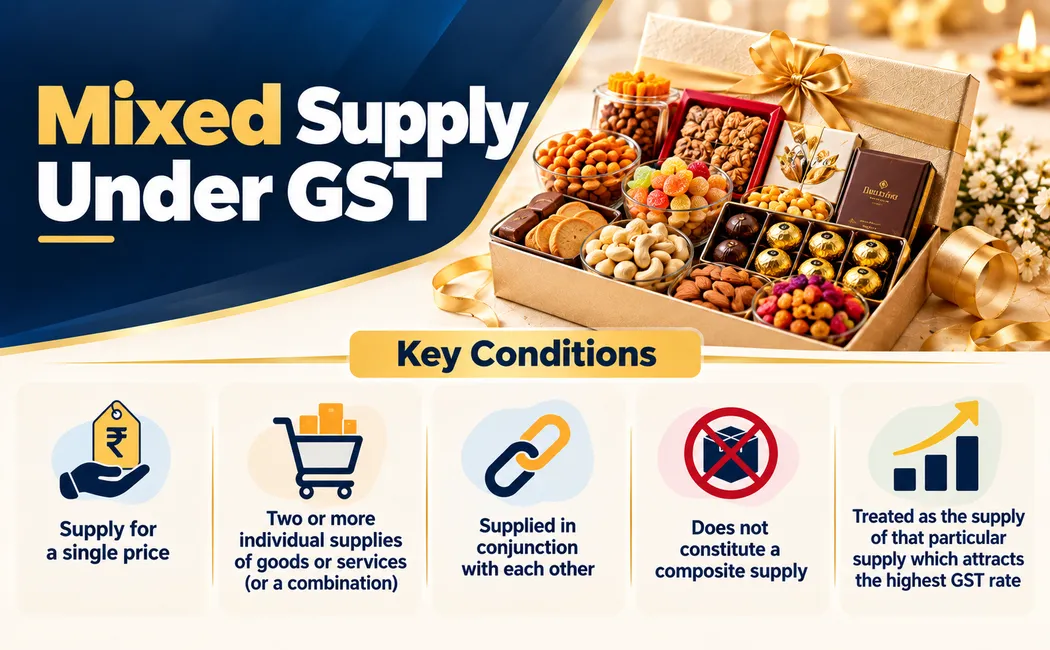
Mixed Supply Under GST: When One Package Can Attract the Highest Tax Rate
For growing businesses,
combining products or services into one package at a single price can be commercially attractive.
Under GST, however, such a package may qualify as a mixed supply,
which can change the tax treatment of the entire transaction.
What Is a Mixed Supply?
A mixed supply generally exists when two or more individual goods or services, or any combination of them, are supplied together for a single price.
The items are supplied in conjunction with each other, but the combination is not a composite supply.
The key point is that the individual items can ordinarily be supplied separately and are not naturally dependent on one another.
How Is a Mixed Supply Taxed?
A mixed supply is treated as the supply of the particular item in the package that attracts the highest GST rate.
Therefore, the inclusion of one higher-taxed item can affect the GST rate applicable to the complete package.
Practical Example
Consider a Chennai business selling a festive gift pack containing sweets, namkeen, biscuits and chocolates for one consolidated price.
Each product can be sold independently.
If the bundle is not naturally bundled, it can qualify as a mixed supply.
Mixed Supply vs Composite Supply
This distinction is important:
a mixed supply consists of independent supplies combined for one price, while a composite supply involves supplies that are naturally bundled in the ordinary course of business.
Key Takeaway
Before launching gift packs, combo offers or bundled service packages, review the individual components, pricing structure and applicable GST rates.
Correct classification at the planning stage helps ensure the appropriate GST treatment from the beginning
CA Sailesh Bhandari
#GST #GSTIndia #BusinessOwners #MSMEIndia #TaxCompliance #Entrepreneurs #CGST

 Call Now