

Blog Detail
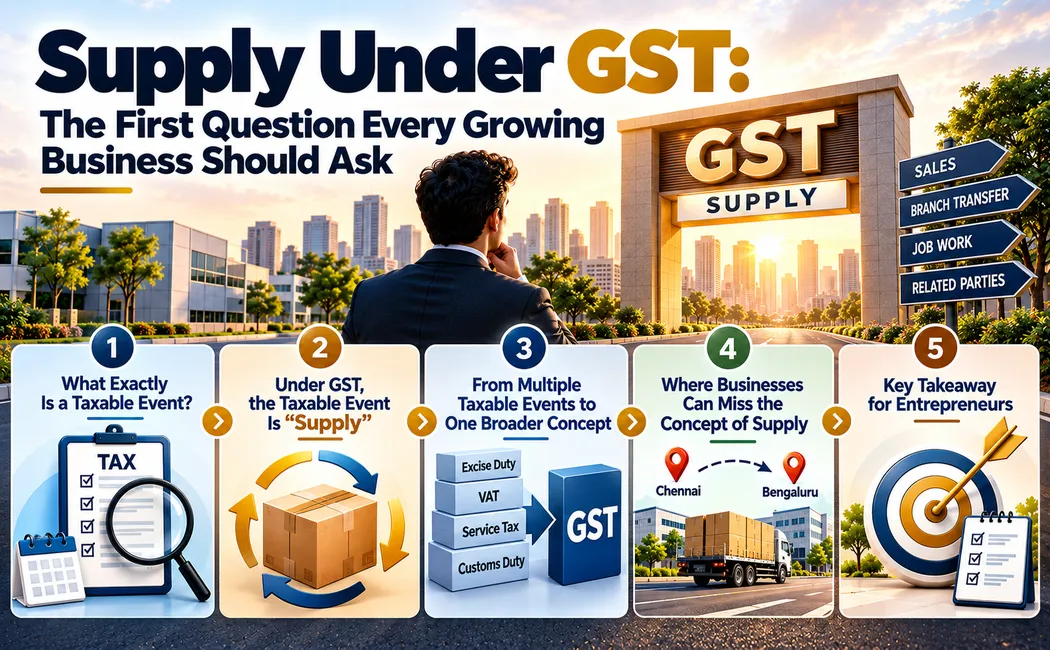
Supply Under GST: The First Question Every Growing Business Should Ask
For most businesses, GST discussions begin with tax rates, input tax credit, e-invoicing or return filing.
But there is a more fundamental question that should come first:
Has a taxable event occurred — and does the transaction qualify as a “supply” under GST?
For businesses ranging from ₹5 crore to ₹500 crore, understanding this distinction is important because it determines where the GST analysis actually begins.
From Multiple Taxable Events to One Broader Concept
Before GST, businesses dealt with different indirect taxes triggered by different events.
Manufacture could attract Excise Duty. Sale of goods could attract VAT or CST. Provision of services could attract Service Tax. Import of goods attracted Customs Duty.
GST substantially consolidated this framework around the broader concept of supply.
Where Businesses Can Miss the Concept of Supply
Consider a Chennai-based manufacturer that also has a separately registered establishment in Bengaluru. Goods transferred from Chennai to Bengaluru may not involve an outside customer or a conventional sale.
However, because establishments under separate GST registrations can be treated as distinct persons, such a transfer can constitute a supply even without consideration.
Similarly, an intra-State movement within the same legal entity should not automatically be treated the same way; the GST position can depend on whether separate registrations exist.
This is why “No sale means no GST” is not always a safe assumption.
Key Takeaway for Entrepreneurs
For growing organisations, understanding this concept should form part of the organisation’s internal GST controls—not merely its return-filing process.
Action Point: Ask your finance team to identify transactions beyond normal customer sales, particularly branch and stock transfers, and examine whether they constitute supply under GST.
Before asking “What is the GST rate?”
first ask: “Is there a supply?”
— CA Sailesh Bhandari
#GST #GSTIndia #BusinessOwners #MSMEIndia #Taxation #Entrepreneurs

 Call Now