

Blog Detail
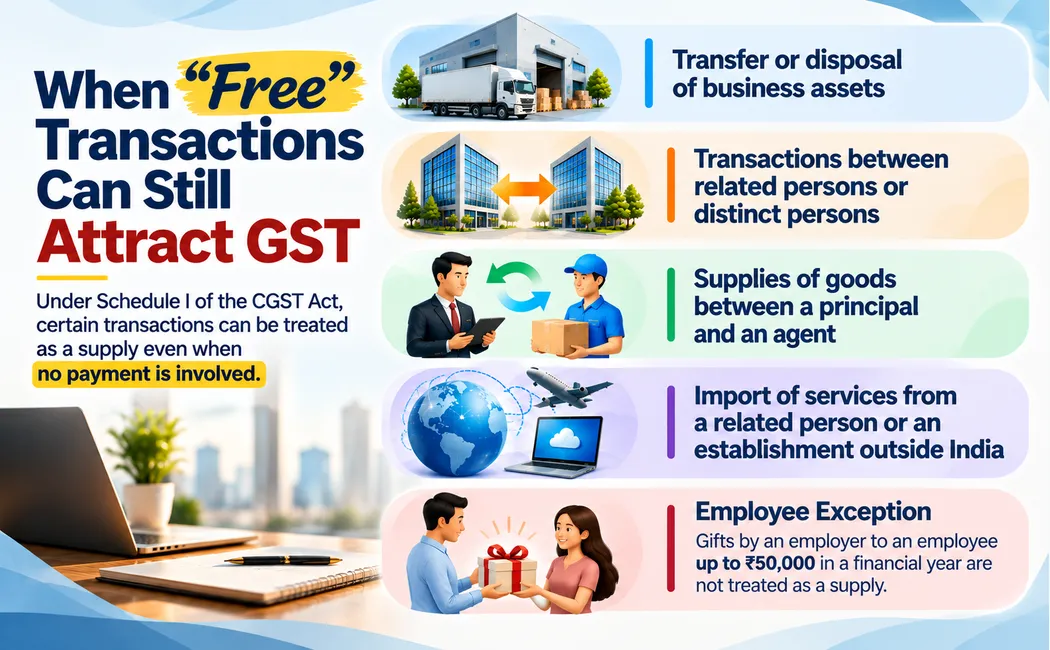
When “Free” Transactions Can Still Attract GST
In business, we normally assume that GST applies when money is received for goods or services.
But under GST, some transactions can be treated as a supply even when no payment is involved.
For businesses with an annual turnover of ₹5 crore to ₹500 crore, this becomes important as operations expand across branches, group companies, agents and overseas entities.
Does No Payment Mean No GST?
Not always.
Normally, consideration or payment is an important part of a supply.
However, Schedule I of the CGST Act identifies certain transactions that can be treated as supply even without consideration.
This means that simply because no invoice is raised or no money is received, a transaction should not automatically be ignored for GST.
When Can a Free Transaction Become a Supply?
Schedule I broadly covers four important situations:
*Permanent transfer or disposal of business assets where input tax credit (ITC) has been availed;
*Transactions between related persons or distinct persons in the course or furtherance of business;
*Certain supplies of goods between a principal and an agent; and
*Import of services from a related person or an establishment outside India in the course or furtherance of business, even without consideration.
A Simple Example
Consider a Chennai-based company that also has a separately registered branch in Coimbatore. Goods are transferred from Chennai to Coimbatore for business use, but no amount is charged between the branches. Since the two GST registrations are treated as distinct persons, the transaction can still be treated as a supply under GST even though no money changes hands.
One Important Employee Exception
Gifts by an employer to an employee up to ₹50,000 in a financial year are not treated as supply under this Schedule. Businesses should therefore keep proper records of employee gifts and their values.
What Should Business Owners Review?
Do not assume
“No payment = No GST.”
Review branch transfers, related-party transactions, business assets given away permanently, principal-agent arrangements and services received from overseas related entities.
Identifying these transactions early can help prevent missed GST liability, interest and unnecessary disputes.
CA Sailesh Bhandari
#GST #GSTIndia #ScheduleI #BusinessOwners #MSMEIndia #TaxCompliance #IndirectTax #Entrepreneurs

 Call Now