

Blog Detail
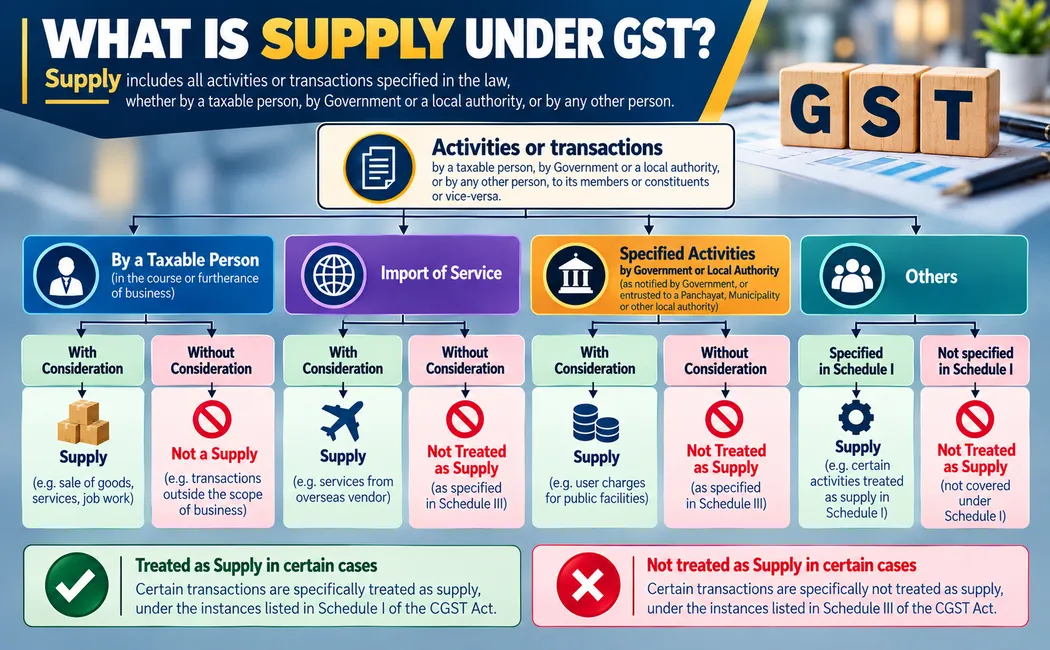
How Is “Supply” Defined Under the CGST Act?
For a business owner, GST does not begin with the tax rate.
The first question is whether a transaction falls within the meaning of “supply” under the CGST Act.
This becomes increasingly important as a business grows from ₹5 crore to ₹50 crore, ₹100 crore or ₹500 crore and its transactions become more diverse.
Supply Is Wider Than a Sale
Section 7 of the CGST Act gives “supply” a wide meaning.
It covers all forms of supply of goods or services or both, such as sale, transfer, barter, exchange, licence, rental, lease or disposal, when made or agreed to be made for consideration by a person in the course or furtherance of business.
For example, a Chennai engineering company may sell machinery to a customer in Coimbatore. That is clearly a supply.
But if the same company leases equipment, licenses business rights, exchanges goods under a commercial arrangement or disposes of business assets, those transactions may also fall within the scope of supply.
Supply Can Exist Even Without Consideration
Another important part of the definition is that certain activities specified in Schedule I are treated as supply even when there is no consideration. This can become relevant for growing businesses with multiple GST registrations, branches, related persons or certain transfers of business assets.
The Practical Takeaway
Business owners should therefore avoid treating their sales register as the complete universe of GST transactions. Review transfers, exchanges, licences, rentals, leases, disposals, member transactions, imported services and specified transactions without consideration.
The right question is not only “Have we made a sale?” but
“Have we made a supply as defined under Section 7 of the CGST Act?”
CA Sailesh Bhandari
Chartered Accountant | GST & Business Advisory
#GST #CGST #GSTIndia #BusinessOwners #MSME #TaxCompliance

 Call Now