

Blog Detail
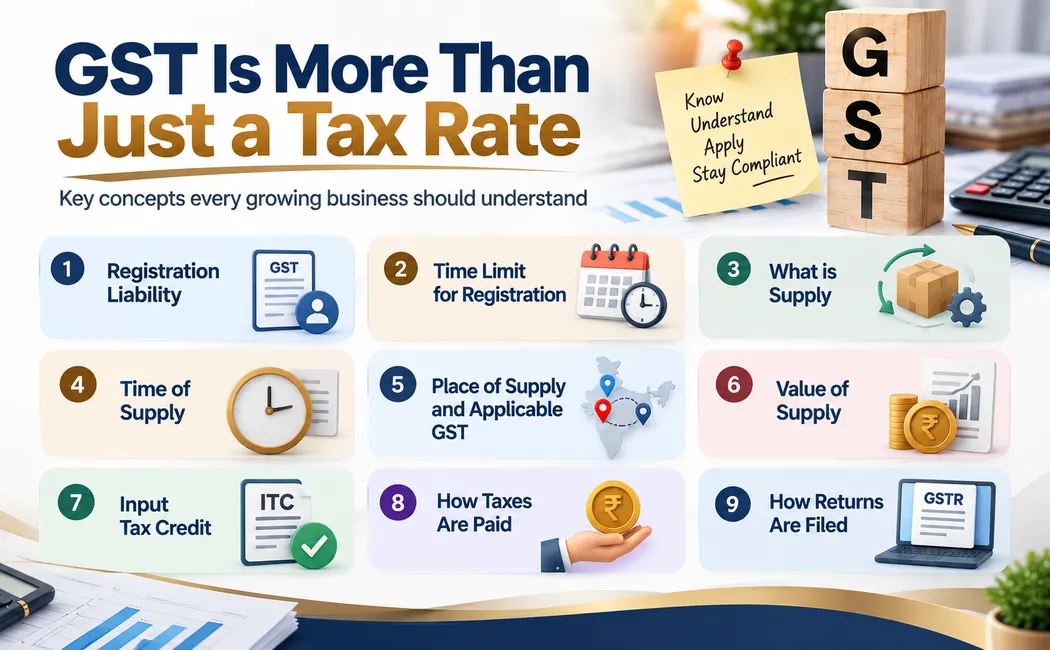
9 Checks Every Growing Business Should Understand
For a ₹5–₹500 crore business,
GST risk rarely begins with the rate.
It begins with getting the transaction, timing, location, value, credit and compliance chain right.
1. Liability & Registration
A business becomes liable to GST when registration is required under the law—
either because the applicable aggregate-turnover threshold is crossed or because compulsory registration provisions apply.
Registration should generally be applied for within 30 days of becoming liable.
2. Supply Comes First
GST applies to a “supply” of goods or services or both,
unless specifically excluded or exempt.
For example,
a Coimbatore manufacturer may sell machinery, undertake job work and provide installation support.
Each activity must first be tested as a supply.
3. Time, Place & Value Decide the Tax
Time of supply determines when GST becomes payable.
Place of supply helps determine whether CGST + SGST/UTGST or IGST applies.
Value of supply determines the amount on which GST is calculated.
4. Input Tax Credit & Tax Payment
Eligible GST paid on business inputs and input services can generally be claimed as Input Tax Credit (ITC),
subject to prescribed conditions and restrictions.
The eligible credit is utilised against output tax liability,
and the balance tax is paid through the electronic cash ledger.
5. Returns Complete the GST Cycle
Regular taxpayers generally report outward supplies through GSTR-1 and discharge liability through GSTR-3B,
subject to the applicable filing frequency.
Annual return/reconciliation requirements should also be reviewed based on the law and turnover applicable for the year.
What Business Owners Should Review
Ask your finance team to map every major revenue stream to five questions:
Is it a supply?
When is tax due?
Where is the place of supply?
What is the taxable value?
Is the ITC eligible?
Then reconcile tax payment and returns with the books regularly.
CA Sailesh Bhandari
#GST #GSTIndia #BusinessOwners #MSMEIndia #TaxCompliance #Entrepreneurs #CGST

 Call Now